


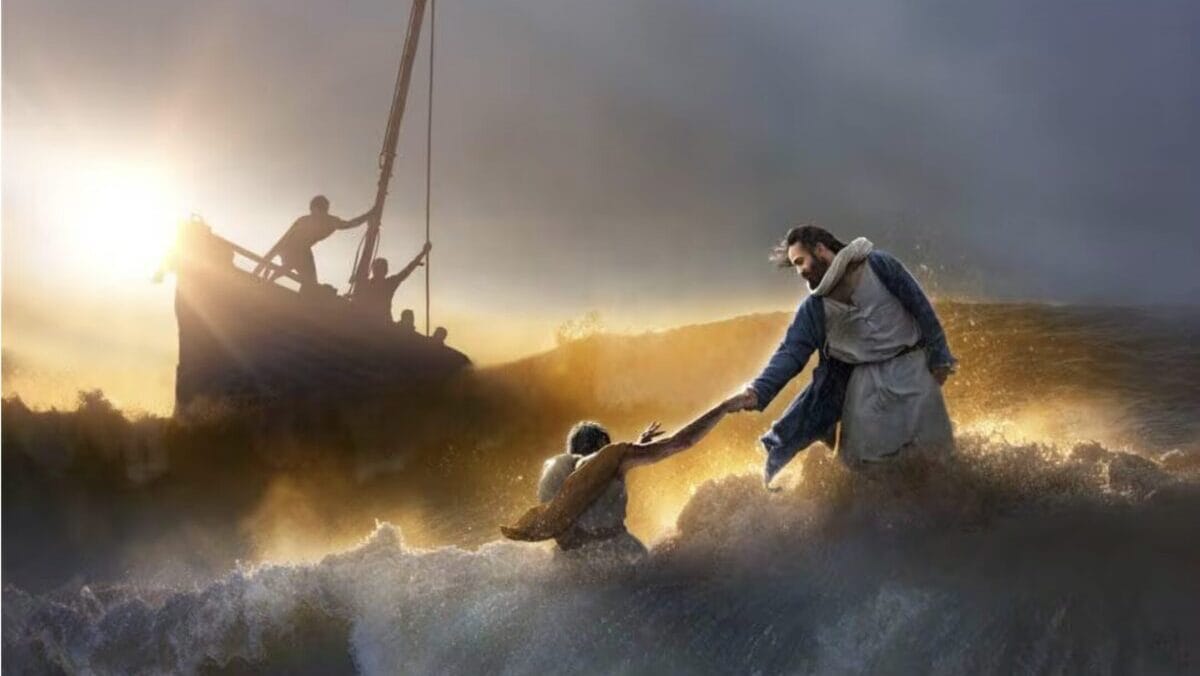
Few images in Western art carry the emotional charge of Jesus walking on water. Painted, sculpted, filmed, and reimagined for nearly two thousand years, the scene from Matthew 14:22–33 remains one of the most frequently depicted moments in all of Scripture. But why this moment? What is it about a storm, a boat, and a figure moving across the waves that keeps pulling artists back, century after century?
The answer lies in the story itself — a scene built on contrast, tension, and transformation. It is, in many ways, a painting waiting to happen.
What Happens in Matthew 14?
Understanding the artistic appeal starts with the narrative. After feeding the five thousand, Jesus sends His disciples ahead by boat while He withdraws to pray. During the night, a storm rises on the Sea of Galilee. In the fourth watch — sometime between 3 and 6 a.m. — the disciples see a figure approaching them on the water and cry out in fear, thinking it is a ghost.
Then comes the moment that has captivated artists ever since: Jesus Christ walking on water speaks the words, “Take heart; it is I. Do not be afraid.” Peter, impulsive as always, asks to join Him. He steps out of the boat, walks a few steps, sees the wind, and begins to sink. Jesus reaches out, catches him, and asks, “You of little faith, why did you doubt?”
In just twelve verses, the passage delivers fear, courage, failure, and rescue. That emotional arc is the engine behind its enduring artistic power.
Why Artists Keep Returning to This Scene
1. Visual Drama Built Into the Story
Painters are drawn to contrast, and Matthew 14 is full of it: darkness and light, chaos and calm, water and flesh, the crowded boat and the solitary figure. Rembrandt captured the violence of the storm. Ivan Aivazovsky, the great Russian marine painter, rendered Christ as a glowing figure on moonlit waves. Each artist finds a different visual truth in the same twelve verses.
2. Peter Makes the Story Human
If the scene were only about the miracle, it might feel distant. Peter changes that. His sinking moment gives every viewer a place to stand — or rather, a place to flounder. Artists from the Byzantine era to modern illustrators have focused on the outstretched hands: Christ’s steady grip meeting Peter’s desperate reach. It is one of the most intimate gestures in religious art, turning a supernatural event into a deeply personal one.
3. A Symbol That Transcends Religion
Even outside faith traditions, “walking on water” has entered everyday language as shorthand for doing the impossible. That cultural reach means the image resonates with audiences far beyond church walls, giving artists a subject that speaks to universal human experiences: fear of drowning in circumstances, the courage to step out, and the hope of being caught when we fall.
Famous Depictions of Christ Walking on Water
Several works stand out in the long visual history of this passage:
- Ivan Aivazovsky, “Jesus Walks on Water” (1888) — A luminous nighttime seascape where Christ appears almost woven from moonlight.
- Julius Sergius von Klever’s maritime interpretations — Emphasizing the vastness of the sea against the smallness of the boat.
- Byzantine mosaics and medieval illuminated manuscripts — Early depictions that established the visual vocabulary of Christ upright on the waves, Peter half-submerged.
- Modern film and stained glass — From cinematic retellings to contemporary church windows, the scene continues to evolve with each new medium.
Each generation reinterprets the moment through its own anxieties and hopes, which is exactly why the image never grows stale.
What This Scene Teaches Beyond the Canvas
The lasting appeal is not only aesthetic. The story functions as a meditation on faith under pressure. Peter does not sink because the storm grows stronger; he sinks because his attention shifts from Christ to the wind. Artists intuitively understand this, which is why so many depictions place the viewer’s eye directly on the line of sight between Peter and Jesus.
For believers, the scene is a promise: help arrives in the fourth watch, often when the night feels longest. For artists, it is a masterclass in composition and meaning. For everyone else, it remains a strikingly human story about what happens when we step beyond what feels safe.


